http://inspiredmood.wordpress.com/2012/05/11/original-anzac-recipe/

Final year Advertising Student creating a communications campaign to engage young, disconnected New Zealanders with Anzac history. My project with be the hypothetical campaign for the (very real) 2015 experiential Anzacs exhibition in Te Papa. I love suggestions, encouragement, critiques and puns! Do get in contact. pseudosoydesign@gmail.com // @thishuei
Thursday, May 9, 2013

Empathy Varies by Age and GenderEarlier research by O'Brien, Konrath and colleagues found declines in empathy and higher levels of narcissism among young people today as compared to earlier generations of young adults.
University of Michigan (2013, January 30). Empathy varies by age and gender: Women in their 50s are tops. ScienceDaily. Retrieved May
Tuesday, May 7, 2013

Anzac 100 and to do
So it's the centennial next year and it's kinda big.
Planning on doing some quickie design work up and posting my project on the site. Why"? Well, why not.
Also working titles:
Culinary Memorial
Palatable Memory
Submit Project:
http://ww100.govt.nz/activities-and-projects
Apply for funding:
http://ww100.govt.nz/funding-sources-for-ww100-commemorations#.UYelrSu6EtU
Scrap that. They said they will not fund anything for university projects. BOO.
To do:
Planning on doing some quickie design work up and posting my project on the site. Why"? Well, why not.
Also working titles:
Culinary Memorial
Palatable Memory
Submit Project:
http://ww100.govt.nz/activities-and-projects
Scrap that. They said they will not fund anything for university projects. BOO.
To do:
- SMP!
- Name the thing.
- Write abstract.
- Make some soldiers out of something edible (Oh no Kingsley Baird did it, but he's cool.)
- Concept ideas and prototype executions.
All before next Friday hooray!
Also sketch up cool concept type idea for poster.
Also sketch up cool concept type idea for poster.
War food war war argh war!


Display of daily ration of POW and combining it with uh, black humour?
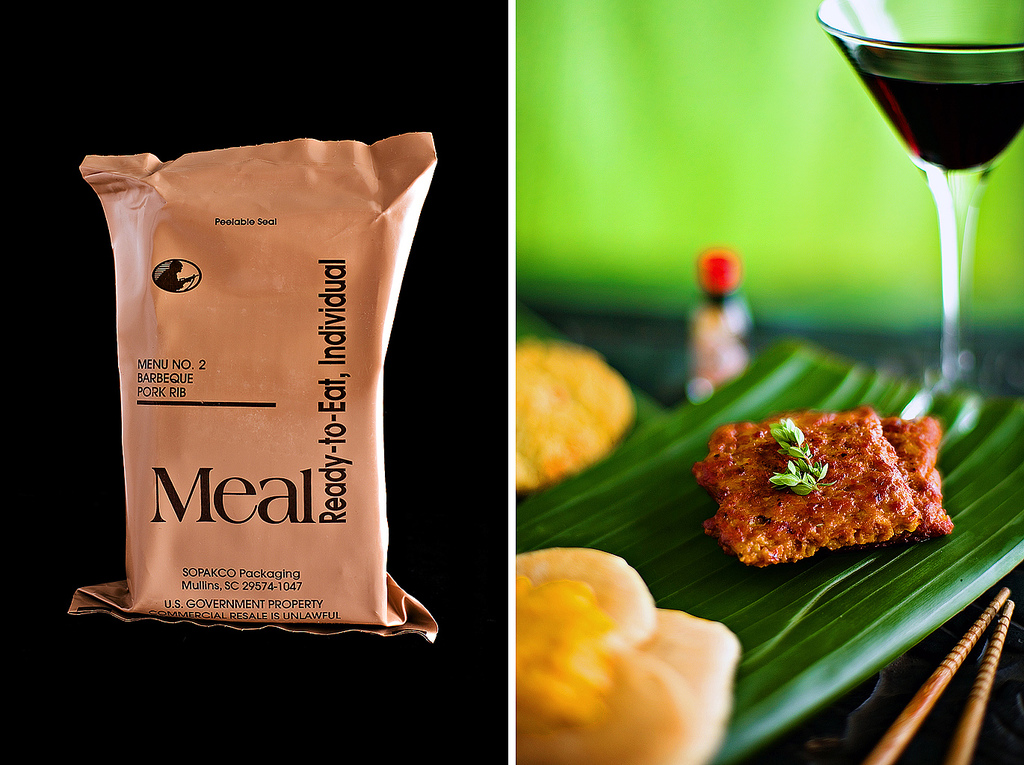
This is a community project to make American MRE (Meals ready to eat) look as appealing as possible to contrast with their extremely drab appearances.




British soldier eating Christmas meal in trench. I like the idea of eating in a trench. It would be nice to somehow replicate that?


Wood mmm yes, print mmm yes.


Staring at these sorts of meals, I can’t help but wonder the kind of solace they bring the soldiers who are so far away from home. In the army camp, a handful of Skittles is priceless.
light-weight meal package can unite a group and remind them of the home they’re fighting for.

light-weight meal package can unite a group and remind them of the home they’re fighting for.


Pretty cool article by NY Times about the different rations each nation gets! Exciting! I don't know why I'm so excited about army rations really. I suppose it's the idea that you have to encapsulate a nation's food within very tight parameters and it's the soldiers' most direct connection to home.
Sunday, May 5, 2013
Anzac Biscuits Culinary Memory
Suspki, S. (2006). Anzac biscuits: a culinary memorial.
Originally published in Journal of Australian Studies, 30 (87), 51–59. Available from: http://dx.doi.org/10.1080/14443050609388050.
---
Writers such as Bell & Valentine, Mintz and Sutton argue that food connects us deeply to our society; it provides a sense of place.
David Bell & Gill Valentine, Consuming Geographies: We Are Where We Eat, Routledge, London, 1997. Sidney Mintz, Tasting Food, Tasting Freedom, Beacon Press, Boston, 1996. David Sutton, Remembrance of Repasts: An Anthropology of Food and Memory, Berg, Oxford, 2001.
Following Siskind, Morley suggests that ‘participation in this ritual ... allows its participants to connect themselves back to the cultural history of the “founding” of their nation’
Siskind, op. cit., p 168; David Morley, Home Territories: Media, Mobility and Identity, Routledge, London, 2000, p 19.
If we define memorial as ‘serving to preserve remembrance’, Anzac biscuits serve as a potent reminder of world war one, Gallipoli and the Anzac spirit. Importantly, Anzac biscuits bring into sharp relief the significant role women played in the war effort.
Wehner suggested that the recipe for Anzac biscuits was developed from a Scottish oatcake recipe. As with oatcakes, Anzac biscuits do not use eggs to bind the ingredients. However, unlike oatcakes, the originality of Anzac biscuits is the use of golden syrup. Eggs were not included because of the need to keep the biscuits fresh on the long journey.
According to anzacday.org.au: ‘Most of these were lucky to maintain a speed of ten knots (18.5 kilometres per hour). Most had no refrigerated facilities, so any food sent had to be able to remain edible after periods in excess of two months.’
This is where golden syrup becomes important — golden syrup is used to bind the biscuits. Women’s culinary creativity inspired the use of golden syrup and, in doing so, ensured the freshness of the biscuits when they reached their loved ones.
Something about ingenuity about using the golden syrup. Ensuring freshness=ensuring the best for loved ones—can be related to loved ones of the future?
Women received letters from loved ones discussing the unappetising rations of bully beef, jam and army biscuits — the original Anzac wafer, or tile. The Anzac tile was essentially a hardtack biscuit that was used as a bread substitute and was extremely hard.
The biscuits have come to represent the courage of the soldiers at Gallipoli and signify the importance women played on the homefront. However, within this narrative is also a sleight of hand: Anzac biscuits link Australians to a time past, to a time that is regarded as “the birth of our nation”. In this sense, Anzac biscuits link Australians powerfully and instantly to a time and place that is regarded as the heart of Australian national identity.
Three representations. Soldiers at Gallipoli; women on homefront, national identity.
Importantly, women are at the centre of the story of Anzac biscuits.
Marilyn Lake has written of the absence of women from the Anzac legend and the birth of the nation:
Gallipoli was hailed as the nation’s birthplace. Australia had had her ‘birth and her baptism in the blood of her sons’. ‘A nation was born on that day of death’ ... The metaphor of men’s procreation involved a disappearing act. In this powerful national myth-making, the blood women shed in actually giving birth — their deaths, their courage and endurance, their babies — were rendered invisible ... Though women gave birth to the population, only men it seemed could give birth to the imperishable political entity of the nation.20
Lake points out, it was women who gave birth to the soldiers who served at Gallipoli, and it was women who also nourished and loved them by sending packages of food, including Anzac biscuits.
I think its interesting where one can find Anzac biscuits these days—supermarket shelves etc. Also interesting how Quantas serves them in flight (makes sense!)—and Air NZ used to. Not sure if they do anymore.
The tradition of the commemoration of Anzac is passed from generation to generation, just as the baking of Anzac biscuits is passed from generation to generation.
Janet Theophano suggests that, ‘recipes [are] memory aids for the cook, especially for baked goods, where precision in ingredients and measurements is critical’
Many people assume that desiccated coconut, or cocoanut as it was first spelled in early cookery books,36 has always been included in the recipe. However, it was a later addition to the recipe, probably added in the mid-1930s.
Anzac biscuits can be regarded as Australia’s national biscuit.38 However, as with the pavlova, New Zealand also claims that they are a New Zealand invention. Unlike the pavlova I doubt that it will be possible to decide which country “owns” Anzac biscuits.39 Anzac biscuits are just as popular in New Zealand and it could be argued that the recipe is a New Zealand invention because of the large Scottish immigrant population that arrived in the nineteenth and early twentieth centuries. New Zealanders suggest that the Anzac biscuit is derived from their Scottish oatcake recipe and Australians “stole” it from them.40
The tradition of making Anzac biscuits powerfully connects the story of Anzac and shows that the food we eat connects us to our society, culture and our public memory.
The story and recipe can be regarded as literature of the kitchen and as Janet Theophano argues such literature, ‘obscures the boundaries of past and present, private and public, self and other, cerebral and corporal. Reading a recipe, preparing and consuming it are, in the end, the word and body become one’.
Crit feedback
from Lee, who is amazing.
- What do you want to achieve?
- How are you going about it?
- Why does this need to be done?
- What do you say? What do they receive?
- Where does this come from? A company selling biscuits? Museum? RSA?
- Cultural Memory, generational memory.
- Not memory, per se, but not forgetting.
- Look at previous Anzac campaigns & communication. Analyze.
Subscribe to:
Posts (Atom)